

Which Statement About The Working Principle Of The Still Camera Is True?


A camera is an optical musical instrument that captures a visual image. At a basic level, cameras consist of sealed boxes (the camera body), with a small pigsty (the aperture) that allows low-cal through to capture an image on a calorie-free-sensitive surface (usually photographic film or a digital sensor). Cameras have diverse mechanisms to control how the light falls onto the light-sensitive surface. Lenses focus the light entering the camera. The aperture can be narrowed or widened. A shutter machinery determines the amount of time the photosensitive surface is exposed to calorie-free.
The still prototype camera is the main instrument in the art of photography. Captured images may be reproduced later every bit part of the process of photography, digital imaging, or photographic printing. Similar artistic fields in the moving-image camera domain are film, videography, and cinematography.
The word photographic camera comes from photographic camera obscura, the Latin name of the original device for projecting an image onto a apartment surface (literally translated to "dark sleeping accommodation"). The modern photographic camera evolved from the camera obscura. The first permanent photo was made in 1825 by Joseph Nicéphore Niépce.[1]
Mechanics [edit]
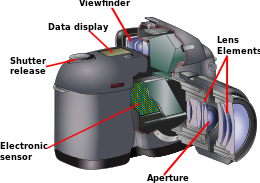
Bones elements of a modernistic digital single-lens reflex (SLR) still camera
Most cameras capture calorie-free from the visible spectrum, while specialized cameras capture other portions of the electromagnetic spectrum, such as infrared.[2] : 7
All cameras utilise the same basic design: light enters an enclosed box through a converging or convex lens and an image is recorded on a light-sensitive medium.[iii] A shutter machinery controls the length of time that light enters the camera.[4] : 1182–1183
About cameras also have a viewfinder, which shows the scene to be recorded, along with means to accommodate various combinations of focus, aperture and shutter speed.[five] : 4
Exposure control [edit]
Aperture [edit]
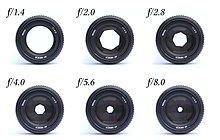
Different apertures of a lens
Light enters a camera through the aperture, an opening adjusted by overlapping plates called the aperture band.[6] [seven] [viii] Typically located in the lens,[9] this opening can be widened or narrowed to alter the corporeality of light that strikes the picture or sensor.[vi] The size of the aperture can be prepare manually, by rotating the lens or adjusting a punch, or automatically based on readings from an internal low-cal meter.[half dozen]
As the aperture is adjusted, the opening expands and contracts in increments called f-stops.[a] [vi] The smaller the f-cease, the more calorie-free is allowed to enter the lens, increasing the exposure. Typically, f-stops range from f/i.4 to f/32[b] in standard increments: ane.4, ii, 2.8, four, five.vi, 8, eleven, 16, 22, and 32.[10] The light entering the camera is halved with each increasing increase.[9]
The wider opening at lower f-stops narrows the range of focus so the background is blurry while the foreground is in focus. This depth of field increases as the aperture closes. A narrow aperture results in a high depth of field, meaning that objects at many different distances from the camera will announced to exist in focus.[11] What is passably in focus is determined by the circle of confusion, the photographic technique, the equipment in use and the degree of magnification expected of the final epitome.[12]
Shutter [edit]
The shutter, along with the aperture, is i of two ways to control the amount of light entering the camera. The shutter determines the elapsing that the light-sensitive surface is exposed to light. The shutter opens, light enters the camera and exposes the film or sensor to calorie-free, and and so the shutter closes.[9] [13]
In that location are two types of mechanical shutters: the leafage-blazon shutter and the focal-aeroplane shutter. The leaf-type uses a round iris diaphragm maintained under spring tension inside or just behind the lens that rapidly opens and closes when the shutter is released.[10]

A focal-plane shutter. In this shutter, the metal shutter blades travel vertically.
More commonly, a focal-plane shutter is used.[9] This shutter operates close to the film plane and employs metal plates or fabric curtains with an opening that passes across the light-sensitive surface. The defunction or plates have an opening that is pulled across the motion picture plane during exposure. The focal-aeroplane shutter is typically used in single-lens reflex (SLR) cameras, since roofing the film (rather than blocking the light passing through the lens) allows the photographer to view the paradigm through the lens at all times, except during the exposure itself. Covering the film also facilitates removing the lens from a loaded camera, as many SLRs have interchangeable lenses.[half-dozen] [10]
A digital camera may use a mechanical or electronic shutter, the latter of which is common in smartphone cameras. Electronic shutters either record information from the entire sensor at the same fourth dimension (a global shutter) or record the information line past line across the sensor (a rolling shutter).[6] In movie cameras, a rotary shutter opens and closes in sync with the advocacy of each frame of motion picture.[6] [14]
The elapsing for which the shutter is open is called the shutter speed or exposure time. Typical exposure times can range from ane second to 1/i,000 of a 2nd, though longer and shorter durations are not uncommon. In the early on stages of photography, exposures were often several minutes long. These long exposure times often resulted in blurry images, as a single object is recorded in multiple places across a single paradigm for the duration of the exposure. To forestall this, shorter exposure times can be used. Very short exposure times tin can capture fast-moving action and eliminate motion mistiness.[xv] [10] [vi] [9] Nonetheless, shorter exposure times require more than light to produce a properly exposed image, so shortening the exposure fourth dimension is not always possible.
Like aperture settings, exposure times increment in powers of two. The two settings make up one's mind the exposure value (EV), a measure of how much low-cal is recorded during the exposure. There is a direct relationship between the exposure times and aperture settings and then that if the exposure time is diffuse one pace, merely the discontinuity opening is besides narrowed one step, then the amount of light that contacts the film or sensor is the same.[nine]
Metering [edit]

A handheld digital light meter showing an exposure of ane/200th at an aperture of f/11, at ISO 100. The light sensor is on acme, under the white diffusing hemisphere.
In most modernistic cameras, the amount of light entering the camera is measured using a built-in light meter or exposure meter.[c] Taken through the lens (called TTL metering), these readings are taken using a panel of light-sensitive semiconductors.[seven] They are used to calculate optimal exposure settings. These settings are typically determined automatically as the reading is used by the photographic camera's microprocessor. The reading from the low-cal meter is incorporated with discontinuity settings, exposure times, and motion-picture show or sensor sensitivity to calculate the optimal exposure. [d]
Lite meters typically average the light in a scene to xviii% eye gray. More advanced cameras are more nuanced in their metering—weighing the center of the frame more than heavily (centre-weighted metering), because the differences in light across the image (matrix metering), or assuasive the lensman to take a lite reading at a specific betoken within the image (spot metering).[11] [fifteen] [16] [6]
Lens [edit]
The lens of a camera captures calorie-free from the subject field and focuses information technology on the sensor. The design and manufacturing of the lens are critical to photo quality. A technological revolution in camera design during the 19th century modernized optical glass manufacturing and lens pattern. This contributed to the modern manufacturing processes of a broad range of optical instruments such as reading glasses and microscopes. Pioneering companies include Zeiss and Leitz.
Camera lenses are made in a broad range of focal lengths, such every bit extreme wide bending, standard, and medium telephoto. Lenses either accept a fixed focal length (prime lens) or a variable focal length (zoom lens). Each lens is best suited to certain types of photography. Extreme wide angles might be preferred for architecture due to their ability to capture a broad view of buildings. Standard lenses commonly take a broad aperture, and because of this, they are frequently used for street and documentary photography. The telephoto lens is useful in sports and wild fauna but is more susceptible to camera shake, which might cause motility blur.[17]
Focus [edit]

The distance range in which objects announced clear and sharp, called depth of field, tin exist adjusted by many cameras. This allows for a photographer to control which objects appear in focus, and which do not.
Due to the optical properties of a photographic lens, only objects inside a limited range of distance from the camera volition be reproduced clearly. The process of adjusting this range is known as changing the camera's focus. In that location are diverse ways to accurately focus a photographic camera. The simplest cameras have fixed focus and use a small aperture and wide-angle lens to ensure that everything within a sure range of distance from the lens, usually around 3 meters (10 ft.) to infinity, is in reasonable focus. Fixed focus cameras are ordinarily inexpensive, such every bit single-use cameras. The photographic camera can likewise have a express focusing range or scale-focus that is indicated on the camera body. The user will approximate or calculate the distance to the subject field and adapt the focus accordingly. On some cameras, this is indicated by symbols (head-and-shoulders; two people standing upright; one tree; mountains).
Rangefinder cameras allow the altitude to objects to be measured employing a coupled parallax unit of measurement on acme of the photographic camera, assuasive the focus to be set with accuracy. Single-lens reflex cameras allow the photographer to determine the focus and composition visually using the objective lens and a moving mirror to project the image onto a ground glass or plastic micro-prism screen. Twin-lens reflex cameras utilise an objective lens and a focusing lens unit of measurement (normally identical to the objective lens) in a parallel body for composition and focus. View cameras use a ground glass screen which is removed and replaced by either a photographic plate or a reusable holder containing sheet picture show earlier exposure. Modern cameras often offer autofocus systems to focus the photographic camera automatically by a variety of methods.[18]
Experimental cameras such as the planar Fourier capture assortment (PFCA) practise not crave focusing to take pictures. In conventional digital photography, lenses or mirrors map all of the low-cal originating from a single point of an in-focus object to a single signal at the sensor plane. Each pixel thus relates an contained piece of data about the far-away scene. In dissimilarity, a PFCA does not accept a lens or mirror, but each pixel has an idiosyncratic pair of diffraction gratings above information technology, allowing each pixel to likewise relate an independent piece of information (specifically, one component of the 2D Fourier transform) nearly the far-away scene. Together, complete scene information is captured, and images can be reconstructed by computation.
Some cameras support post-focusing. Post focusing refers to taking photos that are later on focused on a calculator. The camera uses many tiny lenses on the sensor to capture light from every camera angle of a scene, which is known as plenoptic technology. A current plenoptic camera design has forty,000 lenses working together to grab the optimal picture.[xix]
Prototype capture on film [edit]
Traditional cameras capture light onto photographic plates, or photographic film. Video and digital cameras use an electronic image sensor, usually a charge-coupled device (CCD) or a CMOS sensor to capture images which can be transferred or stored in a retentivity card or other storage inside the camera for afterwards playback or processing.
A broad range of flick and plate formats take been used by cameras. In the early on history plate sizes were frequently specific for the brand and model of cameras although in that location quickly developed some standardization for the more than popular cameras. The introduction of coil movie drove the standardization process still farther then that by the 1950s just a few standard roll films were in use. These included 120 films providing 8, 12 or xvi exposures, 220 films providing 16 or 24 exposures, 127 films providing 8 or 12 exposures (principally in Brownie cameras) and 135 (35mm moving-picture show) providing 12, 20 or 36 exposures – or up to 72 exposures in the half-frame format or bulk cassettes for the Leica Photographic camera range.
For cine cameras, picture show 35mm broad and perforated with sprocket holes was established as the standard format in the 1890s. It was used for about all film-based professional person motility picture product. For amateur use, several smaller and therefore less expensive formats were introduced. 17.5mm motion picture, created by splitting 35mm picture, was one early apprentice format, but nine.5mm moving picture, introduced in Europe in 1922, and 16 mm motion-picture show, introduced in the U.s.a. in 1923, before long became the standards for "home movies" in their corresponding hemispheres. In 1932, the even more economical 8mm format was created by doubling the number of perforations in 16mm film, then splitting it, ordinarily after exposure and processing. The Super viii format, still 8mm broad just with smaller perforations to brand room for essentially larger flick frames, was introduced in 1965.
Movie speed (ISO) [edit]
Traditionally used to tell the camera the pic speed of the selected film on pic cameras, film speed numbers are employed on modern digital cameras as an indication of the system'southward proceeds from light to numerical output and to command the automatic exposure organization. Film speed is unremarkably measured via the ISO 5800 system. The higher the moving picture speed number, the greater the picture sensitivity to light, whereas with a lower number, the film is less sensitive to light.[20]
White balance [edit]
In digital cameras, in that location is electronic compensation for the color temperature associated with a given set of lighting conditions, ensuring that white light is registered as such on the imaging flake and therefore that the colors in the frame will appear natural. On mechanical, movie-based cameras, this office is served by the operator'southward choice of film stock or with color correction filters. In addition to using white residue to annals the natural coloration of the image, photographers may employ white balance to artful end—for instance, white balancing to a blue object to obtain a warm color temperature.[21]
Camera accessories [edit]
Flash [edit]
A flash provides a brusk burst of bright calorie-free during exposure and is a commonly used artificial lite source in photography. Most modern flash systems use a bombardment-powered high-voltage belch through a gas-filled tube to generate bright light for a very short fourth dimension (one/one,000 of a second or less).[eastward] [16]
Many flash units measure the light reflected from the flash to assist determine the appropriate duration of the flash. When the wink is fastened directly to the camera—typically in a slot at the top of the camera (the wink shoe or hot shoe) or through a cable—activating the shutter on the photographic camera triggers the flash, and the camera'southward internal light meter tin help determine the duration of the flash.[xvi] [11]
Additional wink equipment can include a light diffuser, mountain and stand up, reflector, soft box, trigger and cord.
Other accessories [edit]
Accessories for cameras are mainly used for care, protection, special effects, and functions.
- Lens hood: used on the terminate of a lens to block the sun or other calorie-free source to prevent glare and lens flare (come across also matte box).
- Lens cap: covers and protects the camera lens when not in apply.
- Lens adapter: allows the utilise of lenses other than those for which the photographic camera was designed.
- Filter: allows artificial colors or changes light density.
- Lens extension tube: allows close focus in macro photography.
- Care and protection: include camera case and cover, maintenance tools, and screen protector.
- Camera monitor: provides an off-camera view of the composition with a brighter and more colorful screen, and typically exposes more advanced tools such as framing guides, focus peaking, zebra stripes, waveform monitors (oft equally an "RGB parade"), vectorscopes and false color to highlight areas of the prototype critical to the photographer.
- Tripod: primarily used for keeping the camera steady while recording video, doing a long exposure, and time-lapse photography.
- Microscope adapter: used to connect a camera to a microscope to photograph what the microscope is examining.
- Cable release: used to remotely control the shutter using a remote shutter button that tin be connected to the camera via a cable. Information technology can be used to lock the shutter open for the desired period, and it is also commonly used to prevent camera shake from pressing the built-in camera shutter push button.
- Dew shield: prevents moisture build-upwardly on the lens.
- UV filter: can protect the front element of a lens from scratches, cracks, smudges, dirt, dust, and moisture while keeping a minimum impact on image quality.
- Battery and sometimes a charger.
Large format cameras use special equipment that includes magnifier loupe, viewfinder, angle finder, and focusing rail/truck. Some professional SLRs can be provided with interchangeable finders for middle-level or waist-level focusing, focusing screens, eyecup, data backs, motor-drives for moving-picture show transportation or external battery packs.
Principal types [edit]
Unmarried-lens reflex (SLR) camera [edit]
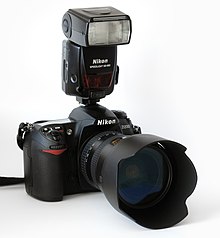
Nikon D200 digital photographic camera
In photography, the unmarried-lens reflex camera (SLR) is provided with a mirror to redirect light from the lens to the viewfinder prior to releasing the shutter for composing and focusing an prototype. When the shutter is released, the mirror swings upwardly and abroad, allowing the exposure of the photographic medium, and instantly returns afterwards the exposure is finished. No SLR camera before 1954 had this feature, although the mirror on some early SLR cameras was entirely operated by the force exerted on the shutter release and only returned when the finger pressure was released.[22] [23] The Asahiflex II, released past Japanese company Asahi (Pentax) in 1954, was the world's start SLR photographic camera with an instant return mirror.[24]
In the single-lens reflex photographic camera, the photographer sees the scene through the photographic camera lens. This avoids the problem of parallax which occurs when the viewfinder or viewing lens is separated from the taking lens. Single-lens reflex cameras have been made in several formats including sheet film 5x7" and 4x5", roll moving-picture show 220/120 taking 8,10, 12, or 16 photographs on a 120 scroll, and twice that number of a 220 picture show. These represent to 6x9, 6x7, 6x6, and 6x4.5 respectively (all dimensions in cm). Notable manufacturers of large format and scroll motion picture SLR cameras include Bronica, Graflex, Hasselblad, Mamiya, and Pentax. However, the most mutual format of SLR cameras has been 35 mm and later on the migration to digital SLR cameras, using about identical sized bodies and sometimes using the aforementioned lens systems.
Almost all SLR cameras use a front-surfaced mirror in the optical path to straight the low-cal from the lens via a viewing screen and pentaprism to the eyepiece. At the time of exposure, the mirror is flipped up out of the low-cal path before the shutter opens. Some early cameras experimented with other methods of providing through-the-lens viewing, including the employ of a semi-transparent pellicle every bit in the Canon Pellix [25] and others with a small periscope such as in the Corfield Periflex series.[26]
Large-format camera [edit]
The large-format camera, taking canvass movie, is a directly successor of the early on plate cameras and remained in use for high-quality photography and technical, architectural, and industrial photography. There are 3 common types: the view camera, with its monorail and field photographic camera variants, and the press photographic camera. They have extensible bellows with the lens and shutter mounted on a lens plate at the front. Backs taking gyre picture and later digital backs are available in addition to the standard dark slide dorsum. These cameras have a broad range of movements allowing very close control of focus and perspective. Composition and focusing are done on view cameras by viewing a ground-glass screen which is replaced by the film to make the exposure; they are suitable for static subjects only and are irksome to employ.
Plate camera [edit]

19th-century studio camera with bellows for focusing
The earliest cameras produced in significant numbers were plate cameras, using sensitized glass plates. Light entered a lens mounted on a lens lath which was separated from the plate by extendible bellows. There were simple box cameras for glass plates merely also unmarried-lens reflex cameras with interchangeable lenses and even for color photography (Autochrome Lumière). Many of these cameras had controls to raise, lower, and tilt the lens forrard or backward to control perspective.
Focusing of these plate cameras was past the utilise of a ground glass screen at the point of focus. Because lens blueprint only allowed rather small aperture lenses, the image on the footing glass screen was faint and most Photographers had a dark cloth to encompass their heads to allow focusing and composition to be carried out more than easily. When focus and composition were satisfactory, the basis glass screen was removed, and a sensitized plate was put in its place protected by a nighttime slide. To make the exposure, the dark slide was advisedly slid out and the shutter opened, and then closed and the dark slide replaced.
Glass plates were later replaced by sail motion-picture show in a dark slide for sheet film; adapter sleeves were made to allow sail film to be used in plate holders. In improver to the ground glass, a simple optical viewfinder was often fitted.
Medium-format camera [edit]
Medium-format cameras have a film size between the large-format cameras and smaller 35 mm cameras.[27] Typically these systems use 120 or 220 curlicue motion picture.[28] The most common prototype sizes are 6×4.v cm, vi×6 cm and 6×seven cm; the older half-dozen×ix cm is rarely used. The designs of this kind of camera show greater variation than their larger brethren, ranging from monorail systems through the archetype Hasselblad model with separate backs, to smaller rangefinder cameras. There are fifty-fifty compact apprentice cameras available in this format.
Twin-lens reflex camera [edit]

Twin-lens reflex cameras used a pair of well-nigh identical lenses: one to form the epitome and one as a viewfinder.[29] The lenses were arranged with the viewing lens immediately above the taking lens. The viewing lens projects an image onto a viewing screen which can be seen from in a higher place. Some manufacturers such equally Mamiya too provided a reflex caput to attach to the viewing screen to allow the camera to be held to the centre when in use. The advantage of a TLR was that it could be easily focused using the viewing screen and that nether most circumstances the view seen in the viewing screen was identical to that recorded on picture. At close distances, withal, parallax errors were encountered, and some cameras also included an indicator to show what office of the limerick would be excluded.
Some TLRs had interchangeable lenses, but as these had to be paired lenses, they were relatively heavy and did non provide the range of focal lengths that the SLR could support. Most TLRs used 120 or 220 films; some used the smaller 127 films.
Compact cameras [edit]
Instant camera [edit]
Subsequently exposure, every photograph is taken through pinch rollers inside of the instant camera. Thereby the developer paste contained in the paper 'sandwich' is distributed on the image. After a minute, the cover sheet but needs to be removed and ane gets a unmarried original positive image with a fixed format. With some systems, it was likewise possible to create an instant epitome negative, from which then could be made copies in the photo lab. The ultimate evolution was the SX-70 system of Polaroid, in which a row of ten shots – engine driven – could be made without having to remove any embrace sheets from the pic. There were instant cameras for a variety of formats, as well equally adapters for instant film use in medium- and big-format cameras.
Subminiature camera [edit]
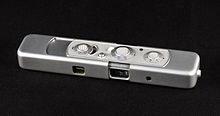
Subminiature cameras were first produced in the nineteenth century and use film significantly smaller than 35mm. The expensive 8×11mm Minox, the simply type of camera produced past the company from 1937 to 1976, became very widely known and was often used for espionage (the Minox company later as well produced larger cameras). Later inexpensive subminiatures were made for general use, some using rewound 16 mm cine film. Image quality with these minor film sizes was limited.
Folding camera [edit]
The introduction of films enabled the existing designs for plate cameras to be made much smaller and for the baseplate to be hinged so that information technology could be folded upwardly, compressing the bellows. These designs were very compact and small models were dubbed vest pocket cameras. Folding curl moving picture cameras were preceded by folding plate cameras, more than compact than other designs.
Box camera [edit]

9Box cameras were introduced as budget-level cameras and had few, if any controls. The original box Brownie models had a small reflex viewfinder mounted on the peak of the photographic camera and had no aperture or focusing controls and just a simple shutter. Later models such every bit the Brownie 127 had larger direct view optical viewfinders together with a curved picture show path to reduce the impact of deficiencies in the lens.
Rangefinder camera [edit]

Rangefinder camera, Leica c. 1936
As camera lens technology adult and wide aperture lenses became more common, rangefinder cameras were introduced to make focusing more precise. Early rangefinders had two split up viewfinder windows, one of which is linked to the focusing mechanisms and moved right or left as the focusing ring is turned. The two separate images are brought together on a ground drinking glass viewing screen. When vertical lines in the object beingness photographed meet exactly in the combined image, the object is in focus. A normal composition viewfinder is also provided. Later the viewfinder and rangefinder were combined. Many rangefinder cameras had interchangeable lenses, each lens requiring its range- and viewfinder linkages.
Rangefinder cameras were produced in half- and full-frame 35 mm and roll moving picture (medium format).
Motion film cameras [edit]
A movie camera or a video camera operates similarly to a notwithstanding camera, except it records a series of static images in rapid succession, commonly at a charge per unit of 24 frames per second. When the images are combined and displayed in order, the illusion of movement is accomplished.[30] : iv
Cameras that capture many images in sequence are known as movie cameras or equally cine cameras in Europe; those designed for unmarried images are still cameras. Still, these categories overlap every bit still cameras are oft used to capture moving images in special effects work and many mod cameras can apace switch between still and move recording modes.
A ciné photographic camera or movie camera takes a rapid sequence of photographs on an image sensor or strips of picture. In contrast to a still camera, which captures a single snapshot at a fourth dimension, the ciné camera takes a series of images, each called a frame, through the employ of an intermittent mechanism.
The frames are later played back in a ciné projector at a specific speed, called the frame charge per unit (number of frames per second). While viewing, a person'due south eyes and brain merge the divide pictures to create the illusion of movement. The first ciné camera was built effectually 1888 and by 1890 several types were being manufactured. The standard film size for ciné cameras was speedily established every bit 35mm pic and this remained in use until the transition to digital cinematography. Other professional standard formats include 70 mm movie and 16 mm film whilst apprentice filmmakers used 9.5 mm film, 8 mm film, or Standard viii and Super 8 before the motility into digital format.
The size and complication of ciné cameras vary profoundly depending on the uses required of the camera. Some professional person equipment is very large and besides heavy to be handheld whilst some apprentice cameras were designed to be very small and light for unmarried-handed operation.
Professional person video camera [edit]

A professional video camera (oftentimes called a television camera even though the utilise has spread across boob tube) is a high-end device for creating electronic moving images (equally opposed to a movie camera, that earlier recorded the images on film). Originally adult for use in television studios, they are now also used for music videos, direct-to-video movies, corporate and educational videos, marriage videos, etc.
These cameras earlier used vacuum tubes and afterwards electronic image sensors.
Camcorders [edit]
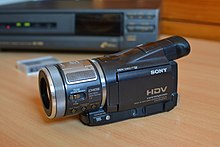
Sony HDR-HC1E, a HDV camcorder.
A camcorder is an electronic device combining a video camera and a video recorder. Although marketing materials may use the colloquial term "camcorder", the name on the package and manual is oft "video camera recorder". Most devices capable of recording video are camera phones and digital cameras primarily intended for all the same pictures; the term "camcorder" is used to describe a portable, self-contained device, with video capture and recording its primary function.
Digital camera [edit]
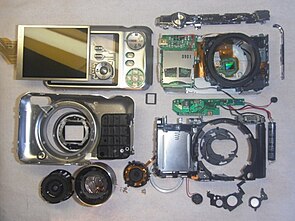
Disassembled Digital Photographic camera
A digital camera (or digicam) is a camera that encodes digital images and videos and stores them for after reproduction.[31] They typically use semiconductor image sensors.[32] Most cameras sold today are digital,[33] and they are incorporated into many devices ranging from mobile phones (called camera phones) to vehicles.
Digital and moving-picture show cameras share an optical system, typically using a lens of variable aperture to focus lite onto an image pickup device.[34] The aperture and shutter acknowledge the correct corporeality of light to the imager, just every bit with film but the paradigm pickup device is electronic rather than chemical. Even so, unlike moving-picture show cameras, digital cameras can display images on a screen immediately after beingness captured or recorded, and store and delete images from memory. Most digital cameras tin besides record moving videos with sound. Some digital cameras tin can crop and sew together pictures & perform other elementary image editing.
Consumers adopted digital cameras in the 1990s. Professional person video cameras transitioned to digital around the 2000s–2010s. Finally, moving picture cameras transitioned to digital in the 2010s.
The first camera using digital electronics to capture and store images was developed past Kodak engineer Steven Sasson in 1975. He used a charge-coupled device (CCD) provided by Fairchild Semiconductor, which provided merely 0.01 megapixels to capture images. Sasson combined the CCD device with moving-picture show camera parts to create a digital camera that saved blackness and white images onto a cassette record.[35] : 442 The images were and so read from the cassette and viewed on a TV monitor.[36] : 225 Later, cassette tapes were replaced by wink retention.
In 1986, Japanese company Nikon introduced an analog-recording electronic unmarried-lens reflex camera, the Nikon SVC.[37]
The first full-frame digital SLR cameras were developed in Japan from around 2000 to 2002: the MZ-D by Pentax,[38] the N Digital past Contax's Japanese R6D team,[39] and the EOS-1Ds by Canon.[twoscore] Gradually in the 2000s, the total-frame DSLR became the dominant camera type for professional photography.[ commendation needed ]
On most digital cameras a brandish, often a liquid crystal brandish (LCD), permits the user to view the scene to be recorded and settings such equally ISO speed, exposure, and shutter speed.[5] : half-dozen–7 [41] : 12
Camera phone [edit]

Smartphone with congenital-in camera
In 2000, Precipitous introduced the world'southward outset digital camera telephone, the J-SH04 J-Phone, in Nippon.[42] By the mid-2000s, higher-terminate jail cell phones had an integrated digital camera, and by the get-go of the 2010s, almost all smartphones had an integrated digital photographic camera.
Run across also [edit]
- Camera matrix
- History of the camera
- Cameras in mobile phones
- List of photographic camera types
- Timeline of historic inventions
Footnotes [edit]
- ^ These f-stops are also referred to every bit f-numbers, stop numbers, or simply steps or stops. Technically the f-number is the focal length of the lens divided past the bore of the effective aperture.
- ^ Theoretically, they tin can extend to f/64 or college.[8]
- ^ Some photographers use handheld exposure meters independent of the camera and use the readings to manually fix the exposure settings on the camera.[16]
- ^ Pic canisters typically incorporate a DX code that tin can exist read by modern cameras so that the camera's computer knows the sensitivity of the moving picture, the ISO.[9]]
- ^ The older type of disposable flashbulb uses an aluminum or zirconium wire in a drinking glass tube filled with oxygen. During the exposure, the wire is burned abroad, producing a bright flash.[xvi]
References [edit]
- ^ "Globe'due south oldest photograph sold to library". BBC News. 21 March 2002. Retrieved 17 November 2011.
The paradigm of an engraving depicting a man leading a equus caballus was made in 1825 by Nicéphore Niépce, who invented a technique known as heliogravure.
- ^ Gustavson, Todd (2009). Camera: a history of photography from daguerreotype to digital. New York: Sterling Publishing Co., Inc. ISBN978-1-4027-5656-6.
- ^ "photographic camera design | designboom.com". designboom | compages & design mag . Retrieved xviii September 2021.
- ^ Young, Hugh D.; Freedman, Roger A.; Ford, A. Lewis (2008). Sears and Zemansky'south University Physics (12 ed.). San Francisco, California: Pearson Addison-Wesley. ISBN978-0-321-50147-9.
- ^ a b London, Barbara; Upton, John; Kobré, Kenneth; Brill, Betsy (2002). Photography (seven ed.). Upper Saddle River, New Jersey: Prentice Hall. ISBN978-0-xiii-028271-two.
- ^ a b c d eastward f 1000 h i Columbia University (2018). "camera". In Paul Lagasse (ed.). The Columbia Encyclopedia (8 ed.). Columbia Academy Printing.
- ^ a b "How Cameras Work". How Stuff Works . Retrieved xiii December 2019.
- ^ a b Laney, Dawn A. ..BA, MS, CGC, CCRC. "Camera Technologies." Salem Press Encyclopedia of Scientific discipline, June 2020. Accessed 6 Feb 2022.
- ^ a b c d due east f g Lynne Warren, ed. (2006). "Camera: An Overview". Encyclopedia of twentieth-century photography. New York: Routledge. ISBN978-ane-57958-393-four.
- ^ a b c d "engineering of photography". Britannica Academic . Retrieved 13 December 2019.
- ^ a b c Lynne Warren, ed. (2006). "Camera: 35 mm". Encyclopedia of twentieth-century photography. New York: Routledge. ISBN978-1-57958-393-four.
- ^ The British Journal Photographic Almanac. Henry Greenwood and Co. Ltd. 1956. pp. 468–471.
- ^ Rose, B (2007). "The Camera Defined". The Focal Encyclopedia of Photography. Elsevier. pp. 770–771. ISBN978-0-240-80740-9 . Retrieved 12 December 2019.
- ^ "Motility-moving-picture show camera". Encyclopedia Britannica . Retrieved 12 Dec 2019.
- ^ a b "Camera". World Encyclopedia. Philip's. 2004. ISBN978-0-19-954609-1 . Retrieved 12 Dec 2019.
- ^ a b c d e "camera". Britannica Academic . Retrieved 12 December 2019.
- ^ McHugh, Sean. "Understanding Camera Lenses". Cambridge in Colour. Archived from the original on 19 Baronial 2013.
- ^ Brown, Gary (Apr 2000). "How Autofocus Cameras Work". HowStuffWorks.com. Archived from the original on 30 September 2013.
- ^ Wehner, Mike (19 October 2011). "Lytro camera lets you focus subsequently shooting, now available for pre-lodge". Yahoo! News. Archived from the original on 22 October 2011.
- ^ "How important is film speed?". HowStuffWorks. 7 December 2010. Retrieved 21 September 2021.
- ^ "Understanding White Balance". www.cambridgeincolour.com . Retrieved 21 September 2021.
- ^ Roger Hicks (1984). A History of the 35 mm Even so Camera. Focal Printing, London & Boston. p. 137. ISBN978-0-240-51233-4.
- ^ Rudolph Lea (1993). Annals of 35 mm SLR cameras. Wittig Books, Hückelhoven. p. 23. ISBN978-three-88984-130-8.
- ^ Michael R. Peres (2013), The Focal Encyclopedia of Photography, p. 779, Taylor & Francis
- ^ "Canon Pellix Camera". Photography in Malaysia. Archived from the original on 16 October 2013.
- ^ Parker, Bev. "Corfield Cameras – The Periflex Era". Wolverhampton Museum of Industry.
- ^ Wildi, Ernst (2001). The medium format advantage (2nd ed.). Boston: Focal Press. ISBN978-1-4294-8344-5. OCLC 499049825.
- ^ The transmission of photography. Elizabeth Allen, Sophie Triantaphillidou (10th ed.). Oxford: Elsevier/Focal Printing. 2011. ISBN978-0-240-52037-vii. OCLC 706802878.
{{cite book}}: CS1 maint: others (link) - ^ Burrows, Paul. "The rising and fall of the TLR: why the twin-lens reflex camera is a existent classic". Digital Camera World. Futurity U.s. Inc. Retrieved 27 December 2021.
- ^ Ascher, Steven; Pincus, Edward (2007). The Filmmaker'south Handbook: A Comprehensive Guide for the Digital Age (3 ed.). New York: Penguin Group. ISBN978-0-452-28678-eight.
- ^ Farlex Inc: definition of digital camera at the Gratuitous Dictionary; retrieved 7 September 2013
- ^ Williams, J. B. (2017). The Electronics Revolution: Inventing the Hereafter. Springer. pp. 245–8. ISBN978-3-319-49088-v.
- ^ Musgrove, Mike (12 January 2006). "Nikon Says It's Leaving Film-Camera Business concern". Washington Post . Retrieved 23 February 2007.
- ^ MakeUseOf: How does a Digital Camera Work; retrieved 7 September 2013
- ^ Gustavson, Todd (ane November 2011). 500 Cameras: 170 Years of Photographic Innovation. Toronto, Ontario: Sterling Publishing, Inc. ISBN978-1-4027-8086-eight.
- ^ Hitchcock, Susan (editor) (20 September 2011). Susan Tyler Hitchcock (ed.). National Geographic consummate photography. Washington, D.C.: National Geographic Order. ISBN978-1-4351-3968-viii.
- ^ Nikon SLR-type digital cameras, Pierre Jarleton
- ^ The long, difficult route to Pentax full-frame The long, difficult road to Pentax total-frame, Digital Photography Review
- ^ British Periodical of Photography, Bug 7410-7422, 2003, p. 2
- ^ Canon EOS-1Ds, 11 megapixel total-frame CMOS, Digital Photography Review
- ^ Burian, Peter; Caputo, Robert (2003). National Geographic photography field guide (2 ed.). Washington, D.C.: National Geographic Society. ISBN978-0-7922-5676-two.
- ^ "Evolution of the Camera telephone: From Sharp J-SH04 to Nokia 808 Pureview". Hoista.net. 28 Feb 2012. Retrieved 21 June 2013.
Further reading [edit]
- Ascher, Steven; Pincus, Edward (2007). The Filmmaker'south Handbook: A Comprehensive Guide for the Digital Age (iii ed.). New York: Penguin Group. ISBN978-0-452-28678-viii.
- Frizot, Michel (Jan 1998). "Light machines: On the threshold of invention". In Michel Frizot (ed.). A New History of Photography. Koln, Germany: Konemann. ISBN978-3-8290-1328-4.
- Gernsheim, Helmut (1986). A Concise History of Photography (3 ed.). Mineola, New York: Dover Publications, Inc. ISBN978-0-486-25128-8.
- Hirsch, Robert (2000). Seizing the Calorie-free: A History of Photography. New York: McGraw-Colina Companies, Inc. ISBN978-0-697-14361-7.
- Hitchcock, Susan (editor) (20 September 2011). Susan Tyler Hitchcock (ed.). National Geographic complete photography. Washington, D.C.: National Geographic Society. ISBN978-1-4351-3968-8.
- Johnson, William South.; Rice, Mark; Williams, Carla (2005). Therese Mulligan; David Wooters (eds.). A History of Photography. Los Angeles, California: Taschen America. ISBN978-3-8228-4777-0.
- Spira, S.F.; Lothrop, Jr., Easton S.; Spira, Jonathan B. (2001). The History of Photography as Seen Through the Spira Collection. New York: Aperture. ISBN978-0-89381-953-8.
- Starl, Timm (Jan 1998). "A New World of Pictures: The Daguerreotype". In Michel Frizot (ed.). A New History of Photography. Koln, Germany: Konemann. ISBN978-iii-8290-1328-4.
- Wenczel, Norma (2007). "Part I – Introducing an Instrument" (PDF). In Wolfgang Lefèvre (ed.). The Optical Camera Obscura II Images and Texts. Within the Camera Obscura – Optics and Art nether the Spell of the Projected Image. Max Planck Institute for the History of Scientific discipline. pp. thirteen–thirty. Archived from the original (PDF) on 2 April 2012.
External links [edit]
 | Wikimedia Commons has media related to Camera. |
- How cameras works at How stuff works.

Source: https://en.wikipedia.org/wiki/Camera
Posted by: mcdonaldroure1972.blogspot.com
0 Response to "Which Statement About The Working Principle Of The Still Camera Is True?"
Post a Comment